
Part 107 Study Guide
Airport Operations
Traffic patterns, runway markings, light gun signals, wake turbulence, PAPI/VASI, and how to safely operate sUAS near airports without creating hazards to manned aircraft.
23 questions in this topic
Sample Questions
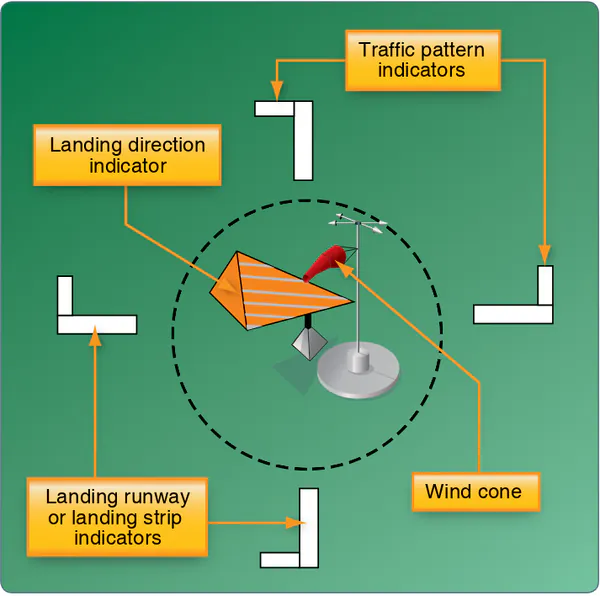
A segmented circle at an airport provides information about:
A segmented circle, if installed at an airport without an operating control tower, provides traffic pattern information. Its parts are a wind direction indicator (wind cone, wind sock or wind tee), a landing direction indicator (tetrahedron), landing strip indicators, and traffic pattern indicators that show when turns are to the right instead of the standard left. AIM 4-3-4.
A rotating beacon that flashes white-green indicates:
Alternating white and green flashes mean a lighted land airport. White and yellow means a lighted water airport, and green, yellow and white means a lighted heliport. Military airport beacons also flash white and green, but with two quick white flashes between the green flashes. AIM 2-1-9.
💡 Memory tip
White + green = civil land airport. Double white flash + green = military. Add yellow (green-yellow-white) = heliport.
What does a steady red light from an ATC light signal gun mean to an aircraft on the ground?
Towers use light gun signals for aircraft without a radio, or when radio contact cannot be established. For an aircraft on the ground: steady red = STOP, steady green = cleared for takeoff, flashing red = taxi clear of the runway in use, flashing green = cleared for taxi. AIM 4-3-13.
💡 Memory tip
On the ground: steady red = STOP, steady green = cleared for takeoff, flashing red = taxi clear of the runway in use.
Right-of-way rules under Part 107 state that a sUAS must yield to:
14 CFR 107.37(a): each small unmanned aircraft must yield the right of way to all aircraft, airborne vehicles, and launch and reentry vehicles. Yielding means giving way and not passing over, under or ahead of the other aircraft unless well clear. The rule has no exception for airspace class.
14 CFR 107.37
UNICOM is commonly used at non-towered airports for:
UNICOM is a nongovernment air/ground radio station that may provide airport information at public-use airports with no tower or FSS. At an airport without an operating tower, pilots get airport and traffic information from a UNICOM operator or by self-announcing. The UNICOM frequency is usually 122.8, but check the Chart Supplement or sectional. AIM 4-1-9; FAA-G-8082-22 Ch. 7 and Ch. 11.
Ready to practice all topics?
The full exam draws from all 8 topics with weighted distribution — just like the real test.
Start Full Practice ExamAirport Operations FAQ
What is the standard traffic pattern altitude? ▾
AIM 4-3-3 recommends propeller-driven aircraft enter the traffic pattern at 1,000 ft AGL, and large and turbine-powered aircraft at not less than 1,500 ft AGL, unless another altitude is published in the Chart Supplement. Turns are to the left unless otherwise indicated; right patterns show as 'RP' on sectionals. 14 CFR 107.43 bars interfering with traffic patterns.
What does a rotating airport beacon operating during the day mean? ▾
In Class B, C, D and E surface areas, a beacon operating during daylight often indicates weather below basic VFR minimums (ceiling below 1,000 ft and/or visibility below 3 miles). There is no requirement to turn it on, so confirm with the METAR. AIM 2-1-9.