
Part 107 Study Guide
Airspace Classification
Master Class B through G airspace, Special Use Airspace (MOAs, Restricted, Prohibited), TFRs, and the 400-ft rule near structures. Airspace is 20% of the Part 107 exam.
44 questions in this topic
Sample Questions
(Refer to the figure, area 1.) Area 1 lies outside the shaded band around the airport, and no other airspace is charted there. At what altitude does Class E airspace begin at area 1?
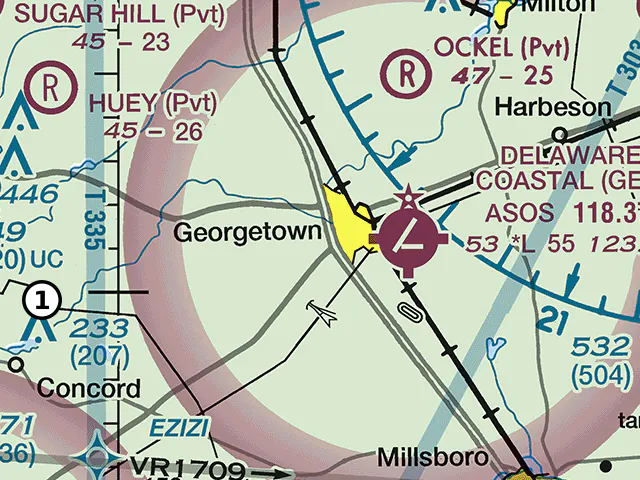
The sectional legend states that Class E airspace exists at 1,200 ft AGL unless otherwise designated. The magenta vignette around Delaware Coastal Airport marks where Class E begins at 700 ft AGL, and a Class E surface area would be drawn with a dashed magenta line. Area 1 is outside the vignette with nothing else charted, so Class E begins at 1,200 ft AGL and Class G lies below it. Sectional chart legend; FAA-G-8082-22 Ch. 2.
💡 Memory tip
Class E presses down on Class G. Where nothing special is drawn, Class E 'kicks in' at 1,200 ft AGL.
To operate a small UAS in Class C airspace, the remote PIC must:
Part 107.41 requires prior authorization from ATC before operating in Class B, C, or D airspace. LAANC provides near-real-time authorization; FAA DroneZone is the manual alternative. 14 CFR 107.41.
14 CFR 107.41
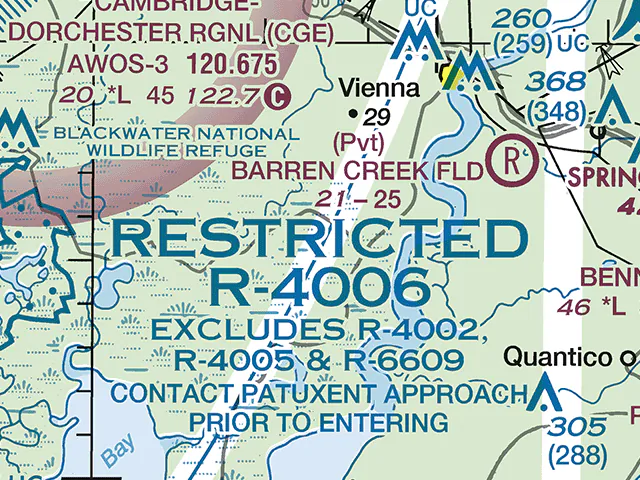
Which type of special use airspace is not wholly prohibited to aircraft, but requires a remote pilot to get permission from the using or controlling agency before flying in it?
In a restricted area (e.g., R-4006), flight is not wholly prohibited but is subject to restrictions, often because of invisible hazards such as artillery firing, aerial gunnery or guided missiles (AIM 3-4-3). Under 14 CFR 107.45 a remote pilot may not fly a small UA in one without permission from the using or controlling agency. In a prohibited area, flight of aircraft is prohibited (AIM 3-4-2). Alert areas are nonregulatory and only inform pilots of heavy training or unusual aerial activity (AIM 3-4-1, 3-4-6).
14 CFR 107.45
💡 Memory tip
Restricted = 'by permission only': not closed outright, but your drone needs the using or controlling agency's OK first.
A remote pilot wants to fly a drone at 650 ft AGL to inspect a cell tower that is 300 ft tall. Is this permitted under Part 107?
14 CFR 107.51(b) allows flight up to 400 ft above a structure's uppermost limit, provided the sUAS remains within a 400-ft radius of the structure. In this case 300 + 400 = 700 ft AGL max near that tower.
14 CFR 107.51(b)
💡 Memory tip
Near a structure, the ceiling becomes 400 ft above its top, but only while you stay within 400 ft of it horizontally.
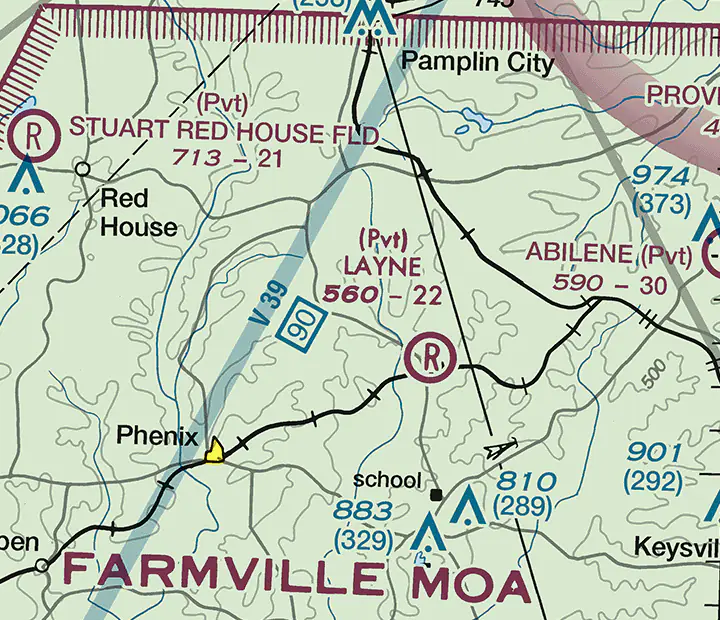
A Military Operations Area (MOA) is depicted on a sectional chart with:
The sectional legend gives MOAs (and alert areas) a magenta hatched border; blue hatching is used for prohibited, restricted and warning areas. MOAs separate military training such as air combat tactics, air intercepts, aerobatics and low-altitude tactics from IFR traffic (AIM 3-4-5). Part 107 requires no ATC authorization or agency permission to fly in a MOA, because 14 CFR 107.41 and 107.45 do not cover them, but the AIM tells VFR pilots to use extreme caution when military activity is under way.
💡 Memory tip
Magenta hatching = MOA, where military jets train. No authorization needed, but use extreme caution when it's active.
Ready to practice all topics?
The full exam draws from all 8 topics with weighted distribution — just like the real test.
Start Full Practice ExamAirspace Classification FAQ
What airspace requires prior authorization for drone operations? ▾
Class B, C, D, and surface Class E airspace require prior ATC authorization under 14 CFR 107.41. LAANC provides near-real-time authorization for many airports; the FAA DroneZone portal handles manual authorization requests where LAANC isn't available.
How high can a drone fly under Part 107? ▾
The standard ceiling is 400 ft AGL. However, 14 CFR 107.51(b) allows flight up to 400 ft above a structure's highest point when within 400 ft horizontally of that structure.
What is a Temporary Flight Restriction (TFR) and how do I check for one? ▾
A TFR is an FAA regulatory action, issued by NOTAM, that restricts certain aircraft from a defined area on a temporary basis. Remote pilots must comply with 14 CFR 91.137–91.145 and 99.7 (14 CFR 107.47). Check tfr.faa.gov, the FAA B4UFLY app, or your preferred preflight planning tool before every flight.