
Part 107 Study Guide
Radio Communications
METAR/TAF weather products, NOTAMs, FSS briefings, AWOS/ASOS, phonetic alphabet, and how to use these resources for preflight planning under 14 CFR 107.49.
18 questions in this topic
Sample Questions
When a METAR includes 'AUTO', it means:
AUTO marks a fully automated report (ASOS/AWOS) with no human intervention. Such a report contains only the weather the sensors can report automatically. When an observer augments or backs up the station, AUTO is dropped. AIM 7-1-10, 7-1-29.
ATIS provides:
Automatic Terminal Information Service (ATIS) is a continuous recorded broadcast of noncontrol information (weather, instrument approach and runway in use) in selected high-activity terminal areas. Each broadcast carries a phonetic letter code and is updated with every official hourly and special weather report, or when data such as the runway in use change. AIM 4-1-13.
Which frequency is the VHF emergency frequency that can be used for distress or urgency communications?
121.5 MHz is the VHF emergency frequency. It can be used for distress or urgency communications and is guarded by direction-finding stations, some military and civil aircraft, military towers, most civil towers, and radar facilities. The other emergency frequency, 243.0 MHz, is guarded by military aircraft. AIM 5-1-11, 6-3-1.
(Refer to the figure, area 1.) In the airport data at area 1, 'CT - 119.425' means:
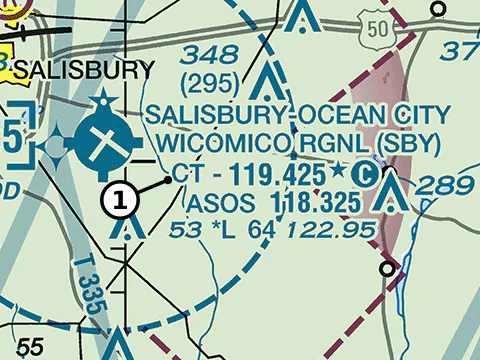
CT means control tower, followed by its primary frequency. The star (★) after it means the tower operates part-time, and the circled C means 119.425 is also the CTAF when the tower is closed. Sectional chart legend; AIM 4-1-9.
💡 Memory tip
CT = control tower frequency. ★ = part-time tower. Circled C = that frequency is the CTAF.
FDC (Flight Data Center) NOTAMs are issued when:
FDC NOTAMs are issued when it is necessary to disseminate regulatory information. They include amendments to published instrument approach procedures and other current charts, TFRs, laser light activity, GPS/WAAS and ADS-B service availability, and special notices. Taxiway closures are NOTAM (D) information. The remote PIC must check NOTAMs before each flight. AIM 5-1-3; AC 107-2A 5.10.3.
💡 Memory tip
FDC = the FAA's regulatory NOTAMs: TFRs and chart/procedure amendments. Check them before every flight.
Ready to practice all topics?
The full exam draws from all 8 topics with weighted distribution — just like the real test.
Start Full Practice ExamRadio Communications FAQ
What is a NOTAM and why does a Part 107 pilot need to check them? ▾
NOTAMs (Notices to Airmen) provide time-critical aeronautical information that is temporary, such as airspace, airport, and hazard changes. 14 CFR 107.49 requires the remote PIC to assess local airspace and any flight restrictions before flight. FDC NOTAMs carry regulatory information and include TFRs.
What is the difference between AWOS and ASOS? ▾
Both are automated surface weather stations, together the primary U.S. surface observing system, run jointly by the NWS, FAA and DoD. AWOS comes in levels: an AWOS-A reports only altimeter setting, while higher levels add wind, visibility, cloud and other sensors. Reports with no human augmentation carry AUTO. AIM 7-1-10.