
Part 107 Study Guide
Sectional Chart Interpretation
Read VFR sectional charts: airspace boundaries, airport symbols, obstacle heights, Special Use Airspace, Victor airways, isogonic lines, and terrain contours.
23 questions in this topic
Sample Questions
(Refer to the figure, area 1.) The airspace at area 1, around Salisbury-Ocean City Wicomico Regional, is:
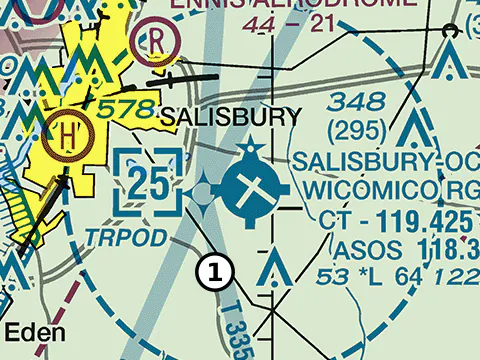
The dashed blue line around Salisbury marks Class D airspace, and the dashed box [25] gives its ceiling in hundreds of feet MSL: 2,500 ft MSL. The CT frequency in the airport data confirms a control tower; the star after it means the tower operates part-time, so check the Chart Supplement or NOTAMs for when the Class D is in effect. Class C is drawn with solid magenta lines and Class B with solid blue lines; a Class E surface area uses dashed magenta, like the extension at lower left. Drone flight inside Class D requires ATC authorization (14 CFR 107.41).
14 CFR 107.41
💡 Memory tip
Solid blue = B, solid magenta = C, dashed blue = D, dashed magenta = surface E.
(Refer to the figure, area 1.) The airspace at area 1, around Richmond International, is:
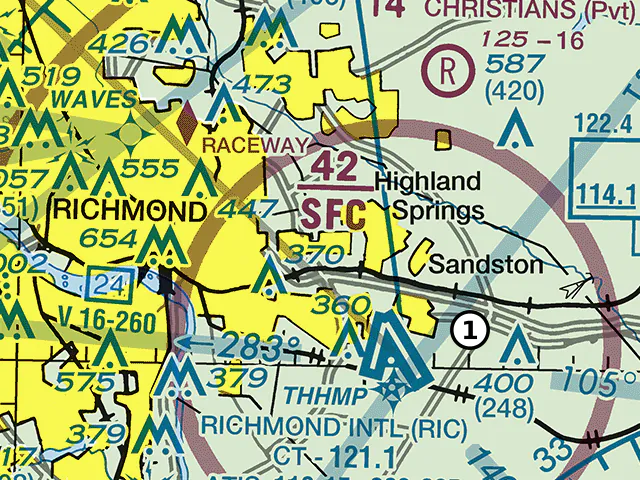
Solid magenta lines mark Class C airspace. The inner circle, labeled 42 over SFC, runs from the surface to 4,200 ft MSL, and area 1 is inside it, so drone flight there requires ATC authorization (14 CFR 107.41). Class C usually consists of a 5 NM radius core surface area and a 10 NM radius shelf area that extends from no lower than 1,200 feet up to 4,000 feet above the airport elevation, so a drone flying beneath the shelf is not in Class C. Class D is dashed blue and Class B solid blue. AIM 3-2-4; FAA Chart Users' Guide and sectional legend.
14 CFR 107.41
💡 Memory tip
Class C is a 2-ring target in solid magenta: the inner 5 NM ring reaches the surface; the outer 10 NM shelf starts no lower than 1,200 ft.
(Refer to the figure, area 1.) What does the number of the military training route at area 1 tell a remote pilot?
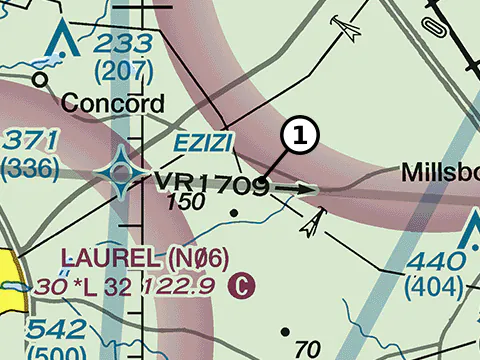
VR1709 has four digits, so no segment of the route is above 1,500 ft AGL. MTRs are used for low-altitude, high-speed military training, generally at speeds above 250 knots. A three-digit route (e.g., IR720) has at least one segment above 1,500 ft AGL. VR routes are flown under VFR and IR routes under IFR. AIM 3-5-2.
💡 Memory tip
MTR digit trick: 4 digits = all segments at or below 1,500 ft AGL. 3 digits = at least one above. More digits, lower route.
(Refer to the figure, area 1.) The airport symbol at area 1 is magenta. This means the airport:
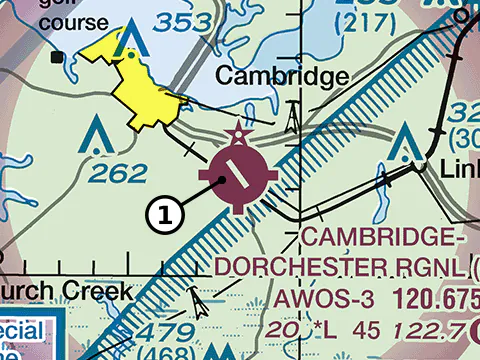
The sectional legend shows airports with control towers in blue and all others in magenta. Cambridge-Dorchester Regional is magenta, so it has no control tower; its data block lists an AWOS-3 frequency and no CT frequency. Military airports are identified by abbreviations such as AFB, NAS or AAF, not by magenta color. FAA Chart Users' Guide.
(Refer to the figure, area 1.) The large number at area 1 is the quadrangle's Maximum Elevation Figure (MEF). It represents:
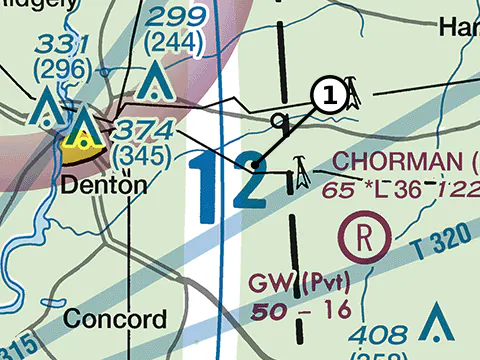
MEFs are the large bold numbers in each quadrant (the area between the 30-minute latitude and longitude lines): the big digit is thousands and the small digit hundreds of feet MSL, so the 12 at area 1 means 1,200 ft MSL. The MEF is the elevation of the highest known terrain or obstacle in the quadrant plus an allowance for possible error, rounded up to the next 100 ft. It is a hazard-awareness figure, not an altitude limit.
💡 Memory tip
MEF = the top of the tallest thing in the box, plus a margin, in MSL. Big digit thousands, small digit hundreds.
Ready to practice all topics?
The full exam draws from all 8 topics with weighted distribution — just like the real test.
Start Full Practice ExamSectional Chart Interpretation FAQ
What do magenta hash marks on a sectional chart indicate? ▾
Magenta hatching outlines Military Operations Areas (MOAs) and Alert Areas; blue hatching marks prohibited, restricted and warning areas. MOAs contain high-speed military training maneuvers. MOAs are nonregulatory, so non-participating aircraft including sUAS are not prohibited, but should exercise extreme caution, get the MOA's hours of operation from an FSS within 100 miles, and contact the controlling agency for traffic advisories before entering an active MOA. AIM 3-4-1, 3-4-5.
What does the number in parentheses beneath an obstacle height figure represent? ▾
On a sectional chart, the number above an obstruction symbol is the elevation of its top in feet MSL, and the number in parentheses below it is its height in feet AGL. For example: '1,235 (335)' means the top of the obstacle is 1,235 ft MSL and 335 ft AGL. FAA Chart Users' Guide.